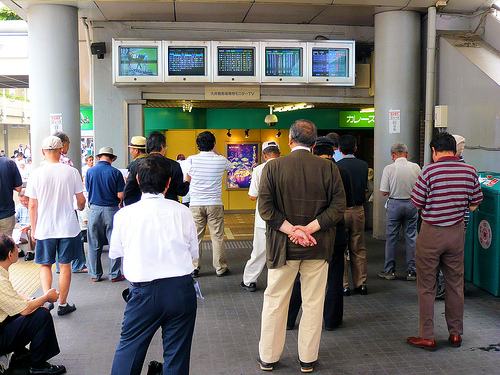
Flickr photo by Stefan
 NY Times: Horse Racing & more Louisville C-J Pace & Cap Forum Dan Illman’s Blog Steve Crist’s Blog Peter Fornatale’s Blog DRF Players’ Podcast
Flickr photo by Stefan
The familiar voice of Santa Anita race caller Trevor Denman is sure to be music to horseplayers’ ears this weekend.
After an 18-day blackout by TrackNet, players at Nevada race books will finally be able to root home their picks while watching races from Santa Anita, Gulfstream and three other tracks.
A verbal agreement was reached Thursday between TrackNet and the Nevada Pari-Mutuel Association. Pari-mutuel pools should be open by Friday and no later than Saturday, pending signatures and regulatory approval.
TrackNet, a partnership of Magna and Churchill racetracks, blacked out five tracks to Nevada casinos beginning on Jan. 26 when the extension ended on an expired contract. During the standoff, horseplayers in 80 Nevada casinos could not watch races or see odds from Santa Anita, Gulfstream, Golden Gate, Oaklawn and Laurel.
Several casinos booked bets, although race parlors had lots of empty seats.
TrackNet and the casinos were haggling over how much of each wagering dollar should go to the tracks and how much the casinos could keep.
Published reports said that TrackNet was asking for a 75 percent increase from the estimated 4-to-5 percent that casinos currently pay. The terms of the new deal were not announced, but TrackNet’s chief executive told the Daily Racing Form that a compromise was reached on a multi-year contract.
“We ultimately came up with something we both could agree with,” said Scott Daruty. “If you ask them, I’m sure they would say they are paying too much. If you asked us, we would say they aren’t paying enough.”
Both Magna Entertainment and Churchill Downs bought several tracks over the last decade, so their combined bargaining position with the casinos is stronger than in the past. But with the United States’ economy in one of its worst economic recessions in history, it seemed senseless for racing to alienate customers with a long blackout.
Last year, Thoroughbred pari-mutuel wagering in the United States, dropped 7.2 percent from $14.72 billion in 2007 to $13.67 billion in 2008 — its lowest total since 1998, according to Equibase.
Also, Las Vegas casino room rates are being slashed and casino gaming win is in decline. The economic picture looks even bleaker for Magna Entertainment, which lost at least $87 million every year from 2005 to 2007. And in the first nine months of 2008, Magna lost another $116 million, according to its third quarter earnings report.
So, with betting dollars in decline, racetracks and casinos both losing money, and Nevada horseplayers eager to flood casino betting windows with cash, reaching a quick compromise made too much sense.
I’m just glad that racing and gaming leaders saw things that way also.
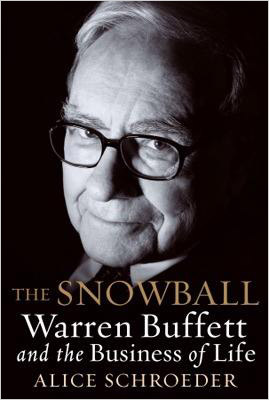
"The Snowball" is available on Amazon for $23 new and $18 used
They say that horse racing is the sport of kings and degenerates.
But really, when boiled down to its essence, horse race handicapping is just an information game much like the stock market. And arguably the most successful stock investor of all time, Warren Buffett, spent his formative years at Ak-Sar-Ben and Charles Town trying to figure out the horse racing game.
“The art of handicapping is based on information,” Buffett said in “The Snowball” his memoir written by Alice Schroeder and published in September 2008. “The key was having more information than the other guy— then analyzing it right and using it rationally.”
Doping out the horses seemed a natural for Buffett because it combined two things that he was good at: gathering information and math.
Buffett’s father did not like attending the races, so Warren began going with either his uncle Frank or the mother of his friend Bob Russell would bring them. Buffett, who wasn’t even a teen-ager when he started going to Ark-Sar-Ben, was too young to bet so he made money stooping for tickets. Then his entrepreneurial spirit kicked in and Buffett and Russell began a tip sheet called Stable-Boy Selections.
“We got away with it for a while,” Buffett said. “They weren’t the hottest sellers in the world. I mean, a couple of little kids selling this thing we typed up in my basement on an old Royal typewriter.
“We were at the track, yelling ‘Get your Stable-Boy Selections!’ But the Blue Sheet was the number-one tip sheet, and the race track was getting a commission on it. The Blue Sheet sold for a little more. At 25-cents, we were a cut-rate product. They shut down the Stable Boy Selections fast because they were getting a cut on everything sold in the place except us.”
Buffett, who was born in 1930, was named the world’s richest man by Forbes magazine in 2008 with a net worth of $58 billion. However, that was before the stock market began it’s 2008 freefall. He is currently the chairman of Berkshire Hathaway, a diversified holding company with large stakes in Coca-Cola, Proctor & Gamble, Johnson & Johnson and American Express.
Although Buffett lived most of his life in Omaha, NE, he did not live all of it there. In 1942, Warren’s father Howard Buffett was elected to the U.S. House of Representatives. Buffett moved with his family from Omaha, NE to Washington D.C. and used the opportunity to upgrade his handicapping skills.
Buffett knew that the Library of Congress had access to every book ever written so he asked his father for a favor.
“When we got to Washington, I said, ‘Pop, there’s just one thing I want. I want you to ask the Library of Congress for every book they have on horse handicapping.’ And my dad said, “Well, don’t you think they’re going to think it’s a little strange if the first thing a new Congressman asks for is all the books on horse handicapping?’ ”
But Buffett reminded his father of the help he gave him during the winning campaign, and pledged to be there for him again during his re-election. So Howard got Warren hundreds of books about handicapping horses.
“Then what I would do is read all these books. I sent away to a place in Chicago on North Clark Street where you could get old racing forms, months of them, for very little. They were old, so who wanted them? I would go through them using my handicapping techniques to handicap one day and see the next day how it worked out. I ran tests of my handicapping ability — day after day — all these different systems I had in mind.”
Buffett broke down the handicapping world into two distinct types, those whose main focus was speed and others who valued class over speed. Speed handicappers like horses who run fast times, while horseplayers who value class prefer those runners dropping down into cheaper races, Buffett said.
“In horse racing, it pays to understand both types of handicapping,” Buffett said. “But back then I was basically a speed guy. I was a quantitative guy to start with.”
Buffett noted that a bookie actually took action inside Washington’s Old House Office Building. “You could go to the elevator shaft and yell, ‘Sammy!’ or something like that and this kid would come up and take bets.”
Even Buffett himself did some bookmaking for guys who wanted to get down on the big races like the Preakness Stakes.
“That’s the end of the game I liked, the 15 percent take with no risk,” Buffett said.
Buffett got along well with his high school golf coach, Bob Dwyer, and the two frequently rode the Chesapeake & Ohio railroad together from Silverspring, MD to Charles Town racetrack in West Virginia. Dwyer taught Buffett how to better understand the Daily Racing Form.
“I’d get the Daily Racing Form ahead of time and figure out the probability of each horse winning the race. Then I would compare those percentages to the odds,” said Buffett, who bet from $6 to $10 to win. “Sometimes you would find a horse where the odds were way, way off from the actual probability. You figure the horse has a 10 percent chance of winning, but it’s going off at 15-to-1.”
One day, Buffett went to Charles Town by himself. He lost the first race and his performance went from bad to worse until he was down $175. Feeling depressed, he went to an ice cream shop and bought himself a sundae with the last of his money.
While eating, Buffett thought to himself that he had just lost more money than he made in a week.
“And I’d done it for dumb reasons,” Buffett said. “You’re not supposed to bet every race. I’d committed the worst sin, which is that you get behind and you think you’ve got to break even that day. The first rule is that nobody goes home after the first race, and the second rule is that you don’t have to make it back the way you lost it. That is so fundamental.”
Editor’s note: MK is a Bershire Hathaway shareholder and attended the 2011 Annual Meeting in Omaha, NE.
Without the excitement of Santa Anita Park racing to talk about on this site due to TrackNet’s Nevada blackout, the Sports Illustrated Swimsuit issue will have to entertain us for the moment.
According to COED magazine with an assist from SPORTSbyBROOKS, this years cover model is Bar Refaeli, a 23-year-old Israeli woman. The announcement was made Monday during a taping of “Late Show with David Letterman.”
Before today’s official word, Refaeli, who is dating actor Leonardo DiCaprio, was a slight favorite to be Sports Illustrated’s top selection for the cover.
I know a guy that talked to someone Monday with inside information on the negotiations between TrackNet and the Nevada Pari-Mutuel Association.
He says that the two sides have been making substantial progress and are “very close to a deal” that will bring back simulcast wagering to Nevada casinos from Santa Anita, Gulfstream, Golden Gate, Laurel and Oaklawn.
Over the weekend, the tracks sent a new proposal and the casinos are considering it.
On Jan. 28, TrackNet prohibited 80 Nevada casinos from taking pari-mutuel wagers on five race tracks, forcing casinos to book the bets or take no action. Since then, Santa Anita, Gulfstream, Golden Gate, Oaklawn and Laurel have been blacked out in Nevada. No television signals are allowed, which means horseplayers cannot watch races coming from any TrackNet venue except Fair Grounds.
TrackNet, a partnership of Magna Entertainment and Churchill Downs, is negotiating with the Nevada Pari-Mutuel Association over the fees casinos pay to take pari-mutuel bets on TrackNet’s races.
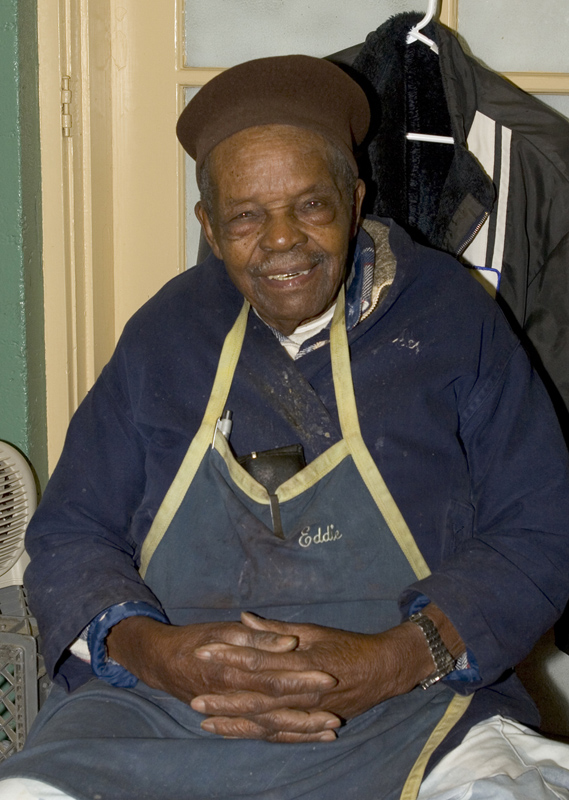
Eddie Logan had been working at Santa Anita since it opened in 1934.
Opened on Christmas 1934, Santa Anita Park has a long and storied history. But on Saturday, a cherished part of the track’s past was lost when the beloved shoe shine man Eddie Logan died.
He was 98.
Logan was remarkable because he was working the day Santa Anita opened some 75 years ago, and had been operating there ever since. In fact, he was almost 100 years old and he was still shining shoes at his stand right up until a few weeks ago. But on Jan. 3, Logan took a seizure while working at the race track and was rushed to Arcadia Methodist Hospital.
Logan never fully recovered and he died at his Monrovia, Ca. home early Saturday morning.
The friendly Logan, known as “The Footman,” typically greeted customers and horseplayers who strode by his stand with “have a lucky day.” In 2006, the Hill Rise Stakes for two-year-olds was renamed the Eddie Logan Stakes and last Dec. 27 Logan was in the winner’s circle for the trophy presentation.
“Truly, Santa Anita will never be the same without him,” said the track’s President Ron Charles on santaanita.com. “He was an inspiration to all of us and I personally feel that my life has been enriched by having known him all these years.
“Eddie loved racing and the people in it,” Charles continued. “He was indeed a window to our past and, although he lived a very long and healthy life, we just wish we could have had a lot more time with him. I think all of us will cherish our memories of Eddie and what he meant to Santa Anita.”
On Saturday, Logan’s stand was covered with a green tarp and a bouquet of flowers was left behind.
A former Negro league baseball player in the 1920’s and ’30’s, Logan often talked about his ball playing days with the Homestead Grays and the Kansas City Monarchs, and of barnstorming tours with Satchel Paige, Babe Ruth and Lou Gehrig. Logan played outfield, shortstop and catcher.
Logan also liked to lecture horsemen about taking care of their boots, and his customers included top trainers and some of the best jockeys to ever ride: Eddie Arcaro, John Longden, Bill Shoemaker, Laffit Pincay and Chris McCarron.
Trainer Richard Mandella struck up a friendship with Logan because he admired Logan’s longevity and enjoyed talking to him.
“He had that great sense of humor and he’d make you laugh. He’d talk about his days with the Kansas City Monarchs and he was just so full of life. He said his dad always told him ‘Keep you mouth shut and your eyes open, and you’ll learn something,’ Mandella said. “I hope Santa Anita maintains his shoe shine stand forever, he was one of a kind.”
When handicapping a race, the Daily Racing Form is a nice blueprint, but by no means do Beyer Speed Figures, half mile times and beaten lengths tell the whole story.
A horse who ran a low Beyer in his last, or who didn’t seem to fire, may still run huge today. As any horseplayer knows, crazy things happen that cause horses to run poorly.
For example, the saddle sometimes slips, jockeys lose their irons, horses take heat strokes, and sometimes the wackier ones try to jump the inner rail. More commonly, losing contenders get caught up in speed duels, go wide on turns, or get blocked in the stretch.
So, a margin of safety is in order. Personally, I will not bet a maiden in Southern California at less than 2-to-1, and I prefer 7-to-2 to 9-to-1.
Using handicapping tools, we can get a good idea about a lot of things that will happen during the race. And that information can be used to judge who the contenders are and what odds we need for a bet.
But no matter how hard horseplayers work, some valuable information will be known only to a few insiders. And there’s nothing unfair or dishonest about it. These jockeys, trainers and owners are simply in position to know some things that almost all horseplayers will not be privy to.
An example of this happened in the ninth race at Santa Anita on Jan. 19.
Jazzin Razz, a 3-year-old gelding, was making his second lifetime start in a $32,000 maiden claiming race at 7 furlongs. In his debut on Dec. 14, Jazzin Razz was 52-to-1 and broke 10 lengths behind 12 other runners. The comment in the Daily Racing Form said “hesitated, off slowly.”
His Beyer Speed Figure was a lowly 38, which is a far cry from the median winning figure for the class of 69. So, Jazzin Razz looked like an automatic throwout.
However, trainer Richard Rosales added blinkers to Jazzin Razz, dropped him slightly in class, and on Jan. 19 the horse sat just off the pace, took the lead in the stretch and was all out to win by a nose.
After the race, Jazzin Razz’ owner and breeder Shirley Girvin found this blog and read my summary of the race. She commented to me that Jazzin Razz’s full sister Razi’s Star also paid a big price of $58 when she broke her maiden back in 2007.
Girvin and her husband Russell operate a small California breeding business and are trying to prove their stallion Raz Lea, who sired Jazzin Razz, by themselves. To date, Raz Lea, who is a son of Arazi, has sired eight runners with four winners, she said in the email.
Then she explained why Jazzin Razz’s debut went so poorly.
“In Jazzin’s first race, the reason he got such a late start was because Alex Solis, through no fault of his own, got his boot caught in the starting gate,” Girvin wrote.
Well, that was very important to know. Because 10 lengths at 6 furlongs equates to 25 Beyer points and if that is added to Jazzin Razz’s 38 it gives him a 63. And that makes him a contender at the juicy price of 15-to-1.
Solis’ boot got stuck. Such flukes happen in racing, and some things are not possible to know. And just because Jazzin Razz had problems in his debut, didn’t mean he was going to win second time out. It just made him a good bet.
Obviously, we’re playing a game with imperfect information, so we need solid prices to make up for all of the things we don’t know, and for all of the races our ignorance will certainly cause us to lose.
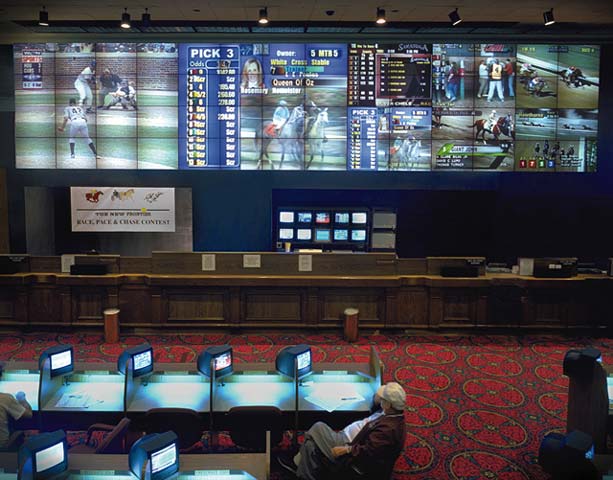
No Santa Anita could mean sparse crowds for books
TrackNet prohibited 80 Nevada casinos Wednesday from taking pari-mutuel wagers on five race tracks, forcing bookmakers to either have the house back the wagers or to take no action on them.
Santa Anita, Gulfstream, Golden Gate and Oaklawn were all blacked out today in Nevada while the fifth track, Laurel, had a scheduled dark day. No television signals were allowed, which means horseplayers could not watch races at TrackNet venues.
TrackNet, a partnership of Magna Entertainment and Churchill Downs, is negotiating with the Nevada Pari-Mutuel Association over the fees casinos pay to take pari-mutuel bets on TrackNet’s races.
Both sides met Wednesday, TrackNet’s Scott Daruty told the Daily Racing Form.
Reportedly several Las Vegas race parlors were booking bets Wednesday, however telephone betting was shut down at South Point, Wynn and Orleans.
Personally, I bet over the telephone. So, until they open the phone rooms again I won’t be posting any race analysis on this site. Instead, I’ll use the down time to catch up research.
 No maiden sprint races were carded on the main track for Wednesday. So I will save my energy for Thursday when we have four maiden claiming sprints, three of which have full fields.
It will be interesting on Wednesday to see if the 80 Nevada casinos make a last minute deal with Track Net on a simulcast agreement. As of Tuesday, no agreement has been made and casinos are reportedly preparing to book bets at Gulfstream Park, Golden Gate Fields, Santa Anita Park, Laurel and Oaklawn, instituting house limits and no pick sixes. Fair Grounds, which is owned by Churchill Downs, has an existing contract with the casinos.
However, I doubt this stare down will last more than a month, because it seems that everybody loses by it: the tracks, the casinos and the horseplayers.
 As I write this, there are 95 days, five hours and five minutes until the bell rings and the gates spring open for Kentucky Derby 135.
The way I know this is that I was just on the newly-updated website kentuckyderby.com. Not much goes on at this site after the previous year’s Derby ends. But a few weeks ago, it was update and upgraded with news and replays of Derby preps, ticket information, lots of opinions, and video of celebrities on the Kentucky Derby red carpet.
I didn’t even know the Kentucky Derby had a red carpet. But this site has a feature called “Buzz from the Red Carpet” where they interview the likes of Dr. J, Taylor Dayne and Hugh Hefner with The Girls Next Door.
However, the interview with Fred Willard puts new meaning on the word “Buzz” in “Buzz from the Red Carpet.” Check it out by clicking under “Red Carpet Videos and Interviews” on kentuckyderby.com.
The Derby site has four handicappers who put up lists of top 3-year-olds pointing for the big race. Some of the common names seen in the top tens of these selectors include Midshipman, Old Fashioned, Vineyard Haven, Pioneerof the Nile and Beethoven
Of course, Churchill Downs officials around Derby time love to talk about all of the upscale folks who come to Louisville for the festivities, like the Queen of England and successful actors and athletes.
But the moon has a dark side and so does Derby Day. Let’s just say that the acceptable modes of behavior are quite different on the infield than they are on Millionaires Row.
During his red carpet interview, World Wrestling Entertainment promoter Vince McMahon was asked how Derby Day compares to one of his wrestling events, he joked, “It is much like WWE because you have beautiful people and you have animals.”
What McMahon may have been referring to is illustrated in the videos below.
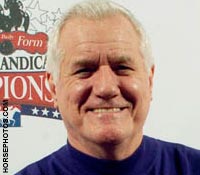
Richard Goodall told race track operators to show bettors more appreciation
Horseplayers don’t need much. But a little friendliness and appreciation would be a nice touch every once in a while, a prominent horseplayer told a room full of horse racing’s elite Monday night at the Eclipse Awards ceremony.
Las Vegan Richard Goodall, 65, told track operators to view bettors as their customers and to do a better job of acknowledging them.
Goodall, who won the 2008 Handicapper of the Year Award at Monday’s Eclipse Awards ceremony, was speaking to the top level of horse racing’s owners, trainers and jockeys. But it was the track managers in attendance in Miami Beach that Goodall seemed to be focused on.
Goodall told the story about his tremendous experience while winning the 2008 NTRA/DRF National Horse Racing Championship at Red Rock Station in Las Vegas. The Red Rock Station staff, he said, made him feel welcome by chatting with him and smiling a lot throughout the event.
Race track operators should greet bettors in the grandstand, Goodall said, and encourage their employees to be more outgoing and friendly. Track managers should also concentrate on important little things that keep customers coming back, he added.
“Make sure the pizza is hot and the beer is cold,” Goodall said.
Goodall also made a plea to Congress to repeal the federal tax on winnings that pay more than 300-to-1 and total more than $600. He called the law outdated from the days when gambling was a sin. Then he argued that the extra money in people’s pockets would help boost the economy because people would use the cash to buy things like automobiles.
The following is the complete list of the 2008 Eclipse Award winners:
Horse of the Year: Curlin.
Two-Year-Old Male: Midshipman.
Two-Year-Old Filly: Stardom Bound.
Three-Year-Old Male: Big Brown.
Three-Year-Old Filly: Proud Spell.
Older Male: Curlin.
Older Female: Zenyatta.
Male Sprinter: Benny the Bull.
Female Sprinter: Indian Blessing.
Male Turf Horse: Conduit.
Female Turf Horse: Forever Together.
Steeplechase Horse: Good Night Shirt.
Owner: Stronach Stables.
Breeder: Adena Springs.
Trainer: Steve Asmussen.
Jockey: Garrett Gomez.
Apprentice Jockey: Pascacio Lopez.
The Eclipse Awards are presented by the NTRA, the National Turf Writers Association and Daily Racing Form in recognition of excellence in Thoroughbred racing.
What is being called a doc-u-drama, a new television show called “Jockeys” captures an inside look at the relationships, risks and rewards of thoroughbred race riding.
The Animal Planet television network will begin airing the series at 9 p.m. E/P on Friday, Feb. 6.
The show was filmed during the 2008 Oak Tree at Santa Anita meet and it focuses on seven jockeys: Aaron Gryder, Jon Court, Joe Talamo, Alex Solis, Mike Smith, Chantal Sutherland and Kayla Stra.
Others seen during a sneek preview on the Animal Planet website, are jockey Corey Nakatani, trainer Jeff Mullins and bettor Jimmy the Hat.
DRF Today The Blood Horse Santa Anita News Bob Baffert’s World On the Backstretch WSJ Sports

 Maiden King